
Three months. Constant lip peeling, burning. Self-medication. Five balms. Two courses of vitamins. A trip to the sea, after which there was relief for exactly a week. And finally a question from the dentist:
“And what toothpaste do you use?”
The cause of the complaints turned out to be the toothpaste. The very same one the patient had been using morning and evening for the past four years.
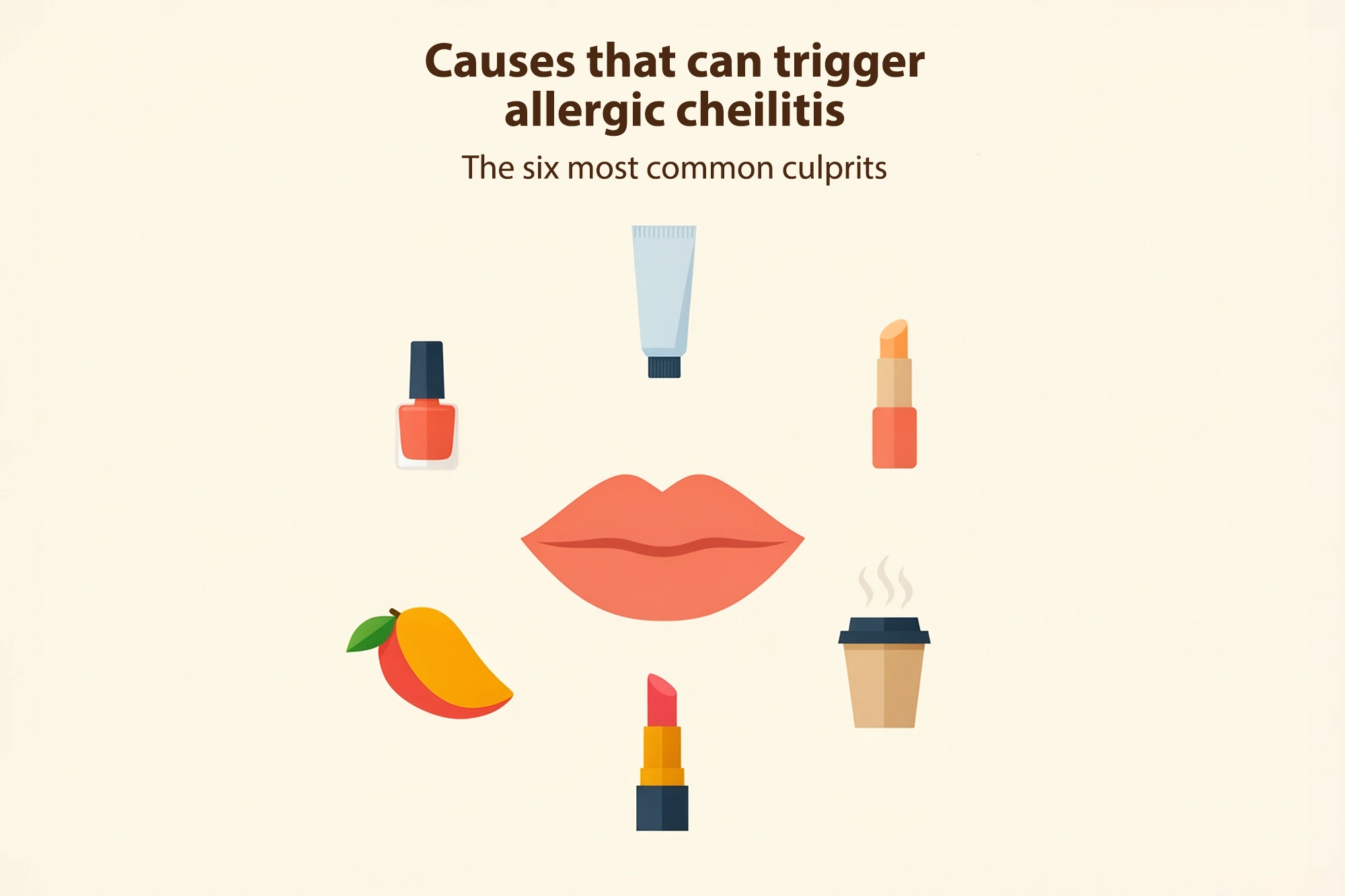
This is not a made-up story. Allergic cheilitis — that is, inflammation of the lips in response to contact with an allergen — belongs to those diagnoses that are easy to miss. The cause is often thought to be:
- the weather, although allergic cheilitis can occur both in summer and in winter;
- a vitamin deficiency, although blood work comes back normal.
In reality, however, the cause may be something the lips come into contact with every day. And usually it is so familiar that it goes unnoticed at first.
How can you tell what exactly is causing allergic cheilitis?
The symptoms can vary: dryness, peeling, small cracks, sometimes redness along the contour of the lips, sometimes a mild itch. There is no pain and no rash. So a person may go on thinking, “my lips are just like that.”
But there are two clues that are almost always present and almost always ignored.
The first is clear localization. The upper and lower lips are inflamed to the same degree, often with the inflammation spreading to the skin around the mouth.
The second is short-term improvement. When you are on holiday, in another city, or you switch your usual toothpaste for a few days, things noticeably get better. Once you return to your usual routine, the symptoms return as well. This is an almost perfect hint that the issue lies not in the skin itself, but in something coming into contact with it.
If these two signs coincide, it is time not to pick a new balm, but to look for the cause.
The three most unexpected culprits behind allergic cheilitis
Toothpaste
Yes, the very one you use twice a day. Here are the three main allergens found in toothpaste:
The first is sodium lauryl sulfate, known by the abbreviation SLS — a widespread detergent that produces abundant foam. It is not a classic allergen, but it markedly irritates the thin skin of the lips and the mucous membrane.
The second is flavorings, above all cinnamon and mint. In dentistry, these are on the list of the most frequent contact allergens.
The third is preservatives and dyes: parabens, formaldehyde releasers, and synthetic dyes.
“Hypoallergenic” balm
The main paradox of this subject is the following. Many balms sold with labels such as “natural,” “organic,” or “hypoallergenic” may contain the very ingredients included in the European baseline series of allergens.
For example, propolis — a bee product made from the resinous secretions of trees — is one of the most frequent natural contact allergens. A patient who has been using a lip balm with propolis for years because it is “natural and good for you” sometimes spends months searching for the cause of the allergy.
Beeswax, karanja oil, and concentrated essential oils of tea tree, lavender, and peppermint are likewise present on contact-allergen lists.
The irony is that a patient with unrecognized allergic cheilitis often gradually switches to ever more “natural” products, hoping that this one will finally help. In reality, they are applying a new potential allergen to their already irritated lips every single day.
Where the main allergens for the lips are hiding
A handy reference to keep nearby. The table below summarizes the allergens most often encountered in cheilitis, along with the non-obvious places where they tend to hide.
| Allergen | Obvious source | Non-obvious source |
| Cinnamaldehyde | Whitening and “hot” toothpastes | Chewing gum, breath fresheners, fruit teas, coffee syrups, flavored baked goods |
| Peppermint | Toothpaste, balms with a “cooling effect” | Cough drops, chewing gum, aromatic oils for the pillow |
| Nickel | Metal appliances in the oral cavity | Coins, keys, watch straps, bag hardware (transferred to the lips via the fingers) |
| Methacrylates | Plastic appliances in the oral cavity | Gel polish and nail extensions, artificial lashes and brows, orthopedic insoles |
| Propolis | “Natural” and “medicinal” balms | Throat lozenges, oral sprays, homemade ointments |
| Lanolin | Lip balms, body creams | Nipple ointments for breastfeeding mothers, leather shoe care products |
| Eosin | Long-lasting lipsticks and tints | Some products with a rosy tint |
The table is not exhaustive but rather a guide. It is useful for grasping the underlying logic: one and the same allergen may reach the lips from several directions at once, and until the source is fully identified, any remission will be short-lived.
Everyday trifles rarely suspected of triggering an allergy
This same category includes things that don’t appear dangerous because they are food items or cosmetics.
A mango eaten with the skin on, like an apple, causes perioral cheilitis due to urushiol — an allergen of the same class as the one in poison ivy (mango and poison ivy belong to the same botanical family, Anacardiaceae). This is an almost textbook diagnostic case that few people are aware of.
Cinnamon in chewing gum, coffee with syrups, baked goods, breath fresheners, and fruit teas continues to act as a trigger in people who have already given up cinnamon in their toothpaste but are still getting it every day from another source.
Nail polish and gel coatings: methacrylates from the nails are transferred to the lips by the fingers, and the lesion may be asymmetric, with the emphasis on the side of the dominant hand.
In lipsticks and lip glosses, the allergen most often turns out to be not “chemicals in general,” but specific ingredients — for example, fragrances, wax, castor oil derivatives, lanolin, eosin, preservatives, or sunscreen filters; less commonly, other dyes.
A separate category is wind instrument musicians: nickel in the mouthpiece, reeds made of cane, plastic in the lip plates. For such a patient, no one connects the cheilitis with rehearsals for a long time.
When it definitely is not allergic cheilitis
Before looking for an allergen, it is worth ruling out conditions that look similar but are treated differently. The most frequent points of confusion are summarized in the table below.
| Condition | What points to the diagnosis | What helps | What not to do |
| Allergic (contact) cheilitis | Symmetry, clear borders, short remissions when daily habits change | Identifying and removing the allergen, patch testing | Don’t try one balm after another |
| Lip-licking cheilitis | A ring along the contour of the lips, in children and in people who often or unconsciously lick their lips | Awareness of the habit, an occlusive barrier | Don’t lick the lips |
| Angular cheilitis (perlèche) | Lesions only in the corners of the mouth, cracks, crusts | Looking for a fungal infection, checking iron and B vitamins, correcting the bite | Don’t apply hormonal ointments haphazardly |
| Actinic cheilitis | A persistent rough patch, predominantly on the lower lip, that does not heal | Examination by a dentist and a dermatologist, biopsy if needed | Don’t delay, don’t mask with balm, don’t sunbathe |
| Exfoliative cheilitis | Constant peeling in flakes without a clear trigger | Comprehensive workup, sometimes a psychiatric consultation | Don’t peel the flakes off yourself |
| Granulomatous cheilitis | Persistent painless swelling of the lip, more often the upper one | Specialized workup | Don’t treat as “an allergy”: the diagnostic approach here is entirely different |
A note specifically about actinic cheilitis. This is a precancerous condition associated with cumulative ultraviolet exposure, predominantly on the lower lip. If a persistent rough patch has appeared there that does not heal, becomes thickened, and peels in flakes, this is a reason to see a dentist as soon as possible.
When you need to see a doctor
- complaints and changes to the lips persist for more than 3 weeks
- the lesion spreads beyond the lips onto the skin.
- flare-ups recur periodically, and each remission is shorter than the previous one
- a persistent rough or thickened patch that does not heal has appeared on the lower lip
In our clinic, dentistry and dermatology work side by side, and this has practical significance precisely for arriving at the correct diagnosis and arranging consultations with allied specialists.