
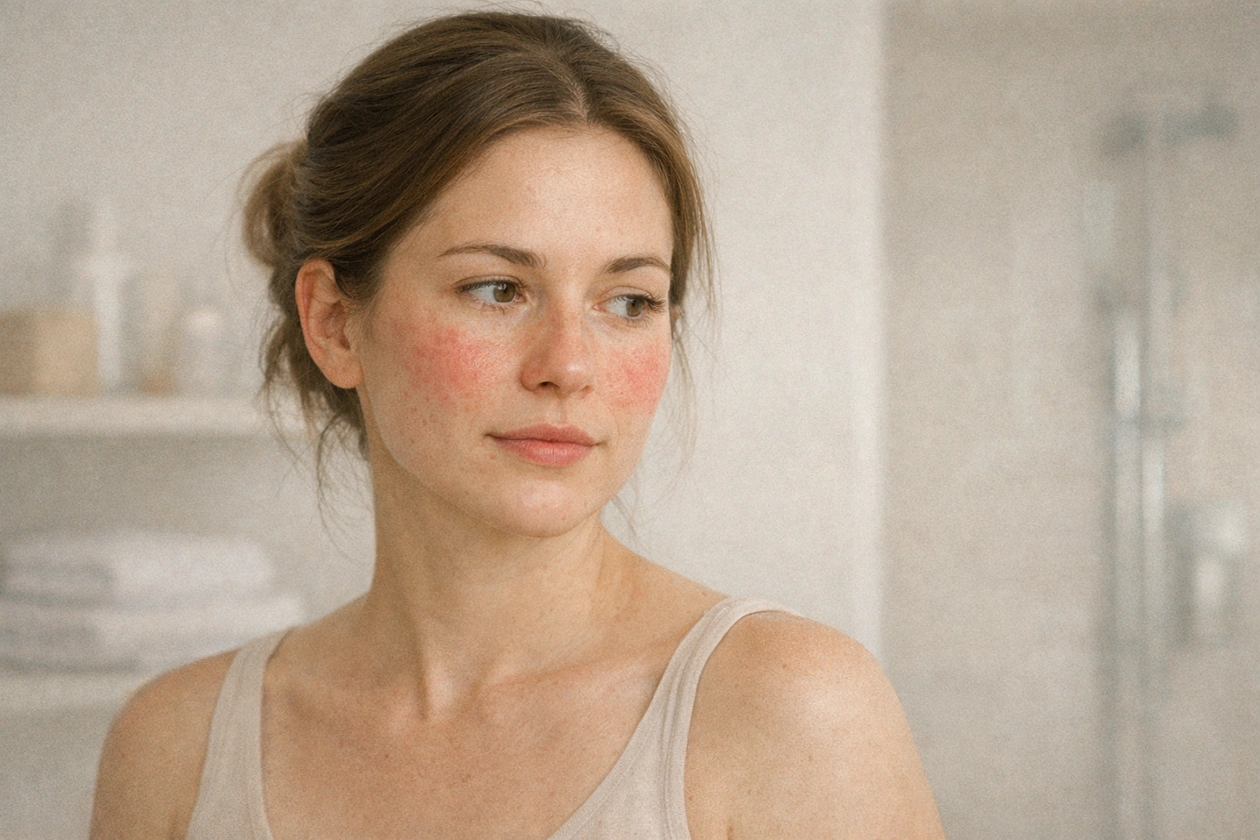
You apply your usual retinol cream in the evening and sunscreen in the morning. Everything seems right. But suddenly your skin starts to burn intensely, turns red, begins to peel, and the SPF that was supposed to protect it stings even more.
At that moment, many people think: “I’m allergic to retinol” or “No SPF works for me.”
In reality, in most such situations, the cause is different: not a true allergy, but irritation, a compromised skin barrier, or a reaction to a specific product formula. And whether you quickly stop the problem or spend weeks “treating” the wrong thing depends precisely on understanding the mechanism correctly.
What Is Retinol and Why Dermatologists Value It So Much
Retinol is one of the forms of retinoids, meaning vitamin A derivatives. In dermatology, this group is valued for its practical clinical results: retinoids help with acne and address uneven texture, pigmentation, and fine wrinkles. The American Academy of Dermatology directly states that retinoids and retinol may be helpful for mild acne, uneven skin tone, and early signs of photoaging.
But there is an important nuance: retinol is not a “neutral” cosmetic ingredient. It is active, and substances of this type often require an adaptation period while the skin gets used to them. That is why dermatologists advise starting slowly, with less intensive formulas, and not applying the product every evening right away if the skin is sensitive.
Separately, the American Academy of Dermatology (AAD) reminds that retinoids should not be used during pregnancy, and people with pronounced dryness, inflammation, skin allergies, or rosacea should introduce them only very cautiously or after consulting a dermatologist.
Allergy vs. Irritation: How They Differ and Why This Is Critically Important
What is often casually called a retinol allergy is much more often actually retinol irritation — in dermatology, this is called retinoid dermatitis or retinoid irritation. This reaction happens not because the immune system has “recognized an enemy,” but because the skin barrier could not tolerate the stress.
Simply put, this is a reaction to damage to the skin’s protective barrier that occurs immediately, without prior buildup of an allergy. That is why burning, dryness, tightness, and peeling after starting retinol are a typical scenario.
Allergic contact dermatitis works differently. It is a delayed-type reaction: first, the skin has to “meet” the allergen and become sensitized, and only then does an immune response occur upon repeated contact. Allergy is more typically associated with itching, swelling, a rash that may extend beyond the application area, and repeated reactions even to a small dose of the product. It is also important to note that the allergen may be not only the retinoid itself, but also auxiliary components of the formula — preservatives, fragrances, and solvents.
Quick table: how to tell allergy from irritation
| Sign | Retinol irritation | Allergic reaction |
|---|---|---|
| How it feels | Burns, stings, dries out, feels tight | More often intensely itchy, may swell |
| Where it appears | Usually where the product was applied | May extend beyond the application area |
| When it occurs | Often at the start or after overdoing the frequency/concentration | After sensitization, sometimes even with a small amount |
| Typical signs | Dryness, redness, peeling, sensitivity | Itchy rash, swelling, eczema |
| What helps | A pause, barrier repair, less frequent application | Complete avoidance of the trigger; sometimes treatment is needed |
| How to confirm it | Often by the clinical picture and symptom dynamics | Patch testing with a dermatologist |
If you have irritation, your skin can often recover with a proper reset of your routine.
If it is an allergy, however, continuing to experiment usually only makes the condition worse, and patch testing is considered the gold standard for confirmation.
Why SPF Can Intensify or Mask a Reaction to Retinol
In theory, the combination of retinol and sunscreen looks ideal: in the evening you work on texture and pigmentation, and during the day you protect the skin from UV damage. And this is indeed the correct logic. In its 2024 guideline, the Journal of the American Academy of Dermatology (JAAD) notes that topical retinoids may increase photosensitivity, and daily sun protection reduces the risk of sun damage.
The problem is different: when retinol has already irritated the skin, the barrier becomes more vulnerable. On such skin, even a good SPF may sting simply because the nerve endings and the upper layer of the epidermis are temporarily too vulnerable. Add sweat, heat, wind, and various active ingredients from other skincare products — and morning sunscreen application is perceived as the “culprit,” although it is only being applied to already irritated skin.
There is also a second scenario: the SPF does not just sting, but truly is a separate trigger. A 2024 review in the Indian Dermatology Online Journal reminds that sunscreens can cause allergic contact dermatitis, photodermatitis, or photoallergy; the reaction may be triggered not only by UV filters, but also by auxiliary components of the formula. That is why a person may think they have a “retinol allergy,” when in fact the skin is reacting to a specific SPF — or vice versa, may blame sun protection when the problem actually started because retinol was introduced too aggressively.
One more important point: SPF can mask the problem. If sun protection is used consistently, you will not get additional UV-induced inflammation, and the reaction may look “tolerable” — just dryness and mild redness. But if you skip protection for a few days, more pronounced redness, burning, and post-inflammatory pigmentation appear more quickly on irritated skin. This is especially important for skin prone to dark spots after inflammation.
Risk Groups: Who Is Especially Vulnerable
Problems most often arise in people who already have sensitive skin or an unstable skin barrier. If you have dryness, a tendency to irritation, rosacea, an atopic background, or past episodes of contact dermatitis, you need to start retinol much more cautiously. The AAD directly notes that people with dryness, skin allergies, and pronounced redness may not tolerate retinoids well without individualized selection.
A separate risk group includes those who like “effective combinations”: retinol plus acids, retinol plus a scrub, retinol plus yet another active ingredient. Even if each product is good on its own, together they can sharply increase the likelihood of irritation. Those who start immediately with a high concentration, apply too much product, or use it daily from the first week are also especially vulnerable.
And one more important nuance is skin prone to post-inflammatory pigmentation. The AAD emphasizes that in people with darker skin tones, irritation may leave dark marks, that is, post-inflammatory hyperpigmentation. That is why a slow start and daily SPF after retinol are especially important here.
How to Tell an Allergic Reaction from Normal Skin Adaptation: A Symptom Checklist
Normal skin adaptation to retinol more often looks like this: mild dryness, a feeling of tightness, moderate redness, slight peeling, and sensitivity in the application area. It is unpleasant, but usually manageable: if you reduce the frequency, let the skin recover, and add good basic skincare, the symptoms become milder.
More concerning signs that suggest an allergy or something beyond “normal adjustment” include intense itching, noticeable swelling, a rash outside the application area, a rash on the eyelids or neck, oozing, crusting, and worsening with each new contact even when using a very small amount of the product. Another red flag is when the problem does not improve after pausing the active products and simplifying the routine.
Checklist for yourself:
- it burns and dries more than it itches — more often irritation
- it itches, swells, the rash “spreads” — think about allergy
- the reaction appears only where the product was applied — more likely irritation
- the reaction repeats after re-exposure to a tiny dose — allergy is more likely
- SPF stings only after retinol, but was fine before — the barrier is probably already damaged
- the skin does not calm down within a few days after stopping active products — a doctor’s evaluation is needed.
What to Do Right Now: A Step-by-Step Action Plan
Step 1. Pause retinol use. Do not just “cut back a little,” do not just “apply less” — actually pause it at least until the active burning, marked redness, and increasing discomfort have gone away. If the cause is irritation, this will reduce inflammation. If it is an allergy, stopping contact is the basic condition for improvement.
Step 2. Simplify your routine as much as possible for 5–7 days. Keep a gentle cleanser, a basic fragrance-free moisturizer, and sun protection. No acids, scrubs, toners, vitamin C, essential oils, or other “boosters.” For sensitive skin, the AAD advises paying attention to fragrance-free products, and among SPFs, mineral formulas with zinc or titanium dioxide are often better tolerated.
Step 3. Check your SPF, but not on the same day your skin is “burning.” If after several days of recovery a mineral SPF no longer stings, then most likely the problem was not the sunscreen itself but the damaged barrier. If, however, the reaction repeats specifically with one SPF, it is worth suspecting a separate sensitivity to that formula and replacing the product.
Step 4. Do not try to “treat” a strong reaction with new active ingredients. This is a typical mistake: adding a soothing serum with a dozen extracts, another acidic toner, or something “for the rash.” The more complicated the regimen, the harder it is to understand what exactly is irritating your skin.
When to See a Dermatologist
You should schedule an appointment with a dermatologist not “when it is convenient,” but without delay if there is marked swelling, oozing, blisters, intense itching, crusting, a rash outside the application area, a reaction on the eyelids, skin pain, cracks, or worsening despite stopping all active ingredients. This is also relevant if the skin reacts the same way every time even to a minimal amount of the product — in that case, allergic contact dermatitis should be ruled out rather than simply assuming it is “intolerance.”
Another reason to come to the clinic is when you cannot tell what exactly you are reacting to: retinol, SPF, or auxiliary skincare ingredients. In such cases, patch testing remains the best and most accurate way to identify the specific allergen.
Conclusion
In short: retinol allergy does exist, but much more often what people call that is ordinary — though very unpleasant — retinol irritation.
SPF, in this situation, is not the enemy but a necessary ally. It is just that on irritated skin it may sting more, or, less commonly, become a separate trigger itself. The best strategy is not to endure it heroically, but to stop using active ingredients in time, restore the barrier, review your skincare routine, and get a dermatological assessment if needed.
If your skin reacts to retinol, SPF burns after retinol, and you cannot figure out the cause on your own, it is worth booking a consultation with a dermatologist. During the consultation, a dermatologist can distinguish normal adaptation from an allergy, rule out contact dermatitis, choose a safe skincare regimen, and bring retinoids back into your routine without constant fear of another flare-up.
Sources:
- AAD, Retinoid or retinol? (2021);
- AAD, Acne: Diagnosis and treatment; AAD, How to decode sunscreen labels (2024);
- AAD, Sunscreen FAQs; Reynolds et al., Guidelines of care for the management of acne vulgaris, JAAD (2024);
- Mahajan et al., Topical Sunscreens: A Narrative Review for Contact Sensitivity…, PubMed/Indian Dermatology Online Journal (2024);
- Patel et al., Irritant Contact Dermatitis — a Review (2022);
- Tramontana et al., Advancing the understanding of allergic contact dermatitis (2023);
- Aquino et al., Managing Contact Dermatitis Without Patch Testing (2024);
- Foti et al., Allergic contact dermatitis from vitamins: A systematic review (2022).